Introduction
Federally Qualified Health Centers serve as the backbone of primary care for millions of underserved Americans. They operate at a uniquely difficult intersection: complex patient needs, limited resources, stringent regulatory requirements, and a mission that demands they keep doing more with less.
Yet FQHCs are often underserved by the very technology that should be helping them. Legacy EMR systems that are difficult to customize, lack interoperability, and generate data silos rather than clinical insight have become a structural barrier to the high-quality, coordinated care that FQHC patients deserve.
Two forces are changing this equation: artificial intelligence and open clinical data standards like OpenEHR. Together, they offer not just modernization, but a path to sustainability — where technology amplifies clinical capacity rather than draining it.
- AI-powered documentation reduces provider charting time by up to 50%, directly addressing burnout in resource-constrained FQHC settings
- OpenEHR creates a longitudinal, vendor-neutral data foundation — enabling true interoperability without costly system migrations
- AI decision support proactively surfaces care gaps, high-risk patients, and evidence-based interventions that would otherwise require significant manual effort
- Automated UDS reporting and compliance monitoring reduces administrative overhead for federally funded organizations
- The AI + OpenEHR combination is modular — FQHCs can modernize incrementally without a complete system overhaul
- Together, these technologies enable more coordinated, personalized, and timely care for the populations FQHCs exist to serve
The Unique Challenges Facing FQHCs
The operational environment of an FQHC differs fundamentally from that of a traditional health system. Patient populations present with complex, layered needs that span medical, behavioral, and social dimensions. Care must be longitudinal, coordinated, and deeply attentive to context that a traditional EMR was never designed to capture.
Administrative burden compounds the clinical challenge. Documentation alone consumes a disproportionate share of provider time. Reporting for programs like the Uniform Data System (UDS) adds further overhead. Compliance with federal regulatory frameworks — HIPAA, HRSA requirements, value-based care metrics — demands constant attention from teams that are already stretched.
The technology problem is not simply one of capability. It is one of fit. Most EMR systems were built for high-volume, well-resourced health systems. FQHCs need systems that are flexible enough to accommodate unique workflows, affordable enough to fit constrained budgets, and interoperable enough to connect with the broader ecosystem of community providers, hospitals, and social services that FQHC patients depend on.
Where AI Makes an Immediate Impact
Applied thoughtfully and within a governed framework, AI can address several of the most pressing challenges FQHCs face today.
Reducing administrative burden
The most immediate and measurable benefit of AI in FQHC settings is documentation. AI-powered tools that capture clinical conversations and automatically generate structured notes can reduce the time providers spend on charting by up to 50 percent. In a setting where physician burnout is a real and present threat to organizational sustainability, this is not a marginal improvement — it is a structural one.
Beyond documentation, AI can automate routine administrative tasks: prior authorization drafting, referral coordination, patient communication, and appointment reminders. Each hour recovered from administrative work is an hour returned to direct patient care.
Enhancing clinical decision support
AI systems operating on longitudinal patient data can surface insights that would otherwise require significant manual effort to identify. High-risk patients who are approaching hospitalization thresholds. Care gaps — missed screenings, overdue chronic disease management visits, unfilled prescriptions. Evidence-based interventions tailored to individual patient profiles rather than population averages.
For FQHC providers managing large, complex panels, this kind of proactive intelligence is the difference between reactive crisis management and genuinely preventive care.
Enabling proactive population health management
FQHCs are deeply committed to population health — but identifying and engaging at-risk populations manually is labor-intensive and inconsistent. AI can automate risk stratification across entire patient panels, flag priority outreach candidates, and help care teams allocate limited resources to the patients who need them most.
This is particularly valuable for chronic disease management programs and for meeting the population-level quality metrics that increasingly drive FQHC funding and recognition.
The Role of OpenEHR: Fixing the Data Foundation
AI is only as good as the data it operates on. This is where OpenEHR becomes foundational.
OpenEHR is an open international standard designed to create a longitudinal, vendor-neutral clinical data repository. Unlike traditional EMRs, which tightly couple data storage with application logic, OpenEHR separates the two. Clinical data is stored in a standardized, semantically rich format using archetypes and templates — structures that are both human-readable and machine-computable.
For FQHCs, this architecture has three critical implications.
**True interoperability** becomes achievable. Data can be shared across systems — community providers, hospitals, social service organizations, payers — without loss of clinical meaning. In a care model that depends on coordination across multiple settings and organizations, this is not a nice-to-have. It is foundational.
**Flexibility without vendor dependency** becomes real. FQHCs have unique workflows, specialized reporting requirements, and evolving care models. With OpenEHR, these can be modeled using standard archetypes without requiring costly vendor-specific customization or long implementation timelines. The standard evolves with clinical practice, not with vendor roadmaps.
**A future-proof data layer** emerges. As new capabilities become available — more sophisticated AI models, new regulatory requirements, advanced analytics platforms — they can be integrated without needing to migrate or restructure core clinical data. The investment in OpenEHR compounds over time rather than depreciating.
The Combined Power of AI and OpenEHR
Individually, AI and OpenEHR are powerful tools. Together, they are transformative — because each addresses the other's most significant limitation.
AI thrives on clean, well-structured, semantically consistent, and longitudinal data. OpenEHR is designed to provide exactly that. An AI system operating on OpenEHR data can understand clinical context more deeply because the data is structured to carry meaning, not just values. It can perform longitudinal analysis across years of patient history because that history is preserved in a consistent format. It can incorporate social determinants of health alongside clinical data because OpenEHR's archetype model supports the full richness of patient context.
This combination unlocks advanced capabilities that are directly aligned with FQHC priorities:
- Risk stratification models that are accurate because they are trained on semantically consistent data
- Care pathway optimization that accounts for the full longitudinal picture of each patient
- Automated quality reporting that is reliable because the underlying data structure aligns with reporting requirements
- Explainable AI recommendations that clinicians can trust because the reasoning is traceable to structured data, not opaque model outputs
Supporting Compliance and Reporting
Regulatory compliance is one of the heaviest administrative burdens FQHCs carry. UDS reporting alone requires aggregating dozens of clinical and operational data elements across an entire patient panel. Value-based care contracts add further measurement and reporting obligations. HIPAA compliance requires ongoing attention to data access, logging, and breach prevention.
AI can substantially reduce this burden by automatically extracting and aggregating required data elements, flagging potential compliance gaps, and generating draft reports for clinical review. OpenEHR ensures that the underlying data is structured in a way that makes this extraction reliable and consistent — rather than requiring custom extraction logic for every reporting cycle.
The result is not just operational efficiency. It is a stronger compliance posture — particularly important for federally funded organizations where audit readiness is not optional.
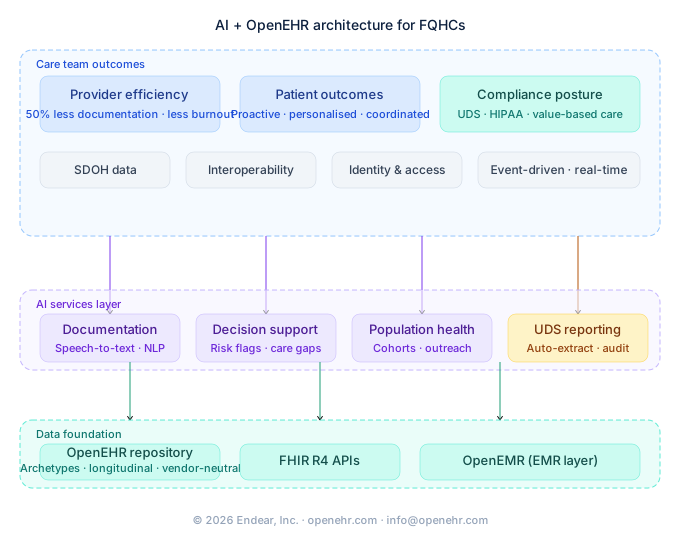
A Modern Architecture for FQHC Innovation
Realizing the full potential of AI and OpenEHR does not require a complete system overhaul. FQHCs can adopt a modular, cloud-native architecture that builds on existing investments while creating a foundation for incremental innovation.
In this architecture, operational workflows continue through a capable EMR layer — systems like OpenEMR that handle day-to-day clinical documentation and scheduling. OpenEHR serves as the longitudinal clinical data platform underneath, ensuring that data is preserved in a standardized, interoperable format regardless of which operational system generated it.
On top of this foundation, organizations can incrementally introduce AI services for documentation, decision support, and population health management. FHIR APIs provide the interoperability layer that connects the FQHC's systems to external partners. Identity and access management ensures that data access is governed and auditable. Event-driven architectures enable real-time data processing for time-sensitive clinical workflows.
This modular approach respects the reality of FQHC operating environments — constrained budgets, limited IT capacity, and the operational risk that comes with any system change. Modernization happens at a pace the organization can absorb, without requiring the big-bang replacements that have derailed many healthcare IT initiatives.
Real-World Impact: What Success Looks Like
When implemented effectively, the combination of AI and OpenEHR delivers outcomes that are measurable and meaningful.
Providers spend less time on documentation and more time in direct patient care — which improves both patient experience and provider satisfaction. Care teams can proactively identify and engage high-risk patients before they reach crisis, reducing emergency utilization and improving chronic disease outcomes. Data becomes an organizational asset rather than an administrative burden, enabling better clinical decisions, more effective reporting, and stronger relationships with payers and community partners.
Most importantly, patients receive more coordinated, personalized, and timely care — which is the core reason FQHCs exist.
Conclusion
FQHCs face some of the most complex operational and clinical challenges in American healthcare. But they also have the greatest potential to benefit from thoughtful technology innovation — precisely because the gap between current capability and what is achievable is so large.
AI can reduce operational strain and elevate clinical intelligence. OpenEHR can provide the robust, interoperable data foundation that makes those AI capabilities reliable and scalable. Together, they offer a path forward that does not require reinventing everything at once — but does require a strategic commitment to open, intelligent, and interoperable systems.
The mission of FQHCs is too important to be constrained by legacy technology. The tools to do better exist today.
See OpenEHR in action.
AI-powered EMR hosting with HIPAA compliance, FHIR APIs, and telehealth built in.
Schedule a Demo