Introduction
For years, Electronic Medical Records have focused primarily on clinical documentation — patients, encounters, prescriptions, and billing. Drug inventory has largely remained an afterthought: loosely tracked, often manual, and rarely integrated into clinical workflows in any meaningful way.
That model is about to break.
The Drug Supply Chain Security Act (DSCSA) introduces a fundamentally different paradigm: unit-level serialization and full traceability of prescription drugs across the entire supply chain. While much of the industry conversation has focused on manufacturers, wholesalers, and large hospital systems, the real disruption is now arriving at the doorstep of medical practices and small dispensers — organizations that are least prepared and most exposed.
This is not simply a compliance requirement that can be addressed with a policy update and a checkbox audit. It is a structural shift in how EMRs must handle inventory, dispensing, and auditability. The practices that understand this early will be positioned to lead. Those that wait will scramble.
- DSCSA transforms drug inventory from quantity-based counting to identity-based tracking — every serialized unit is a uniquely identifiable asset, not just a number in a field
- EMRs must evolve to ingest EPCIS events, validate serial numbers at receiving, and integrate with Verification Router Services (VRS) before dispensing
- Dispensing becomes a regulated act of traceability — the system records not just "1 unit dispensed" but the exact serial number, provenance, lot, and expiration of what was given to which patient
- Small dispensers and medical practices face the steepest adjustment — most existing EMRs have no EPCIS ingestion, no serialized inventory model, and no exception handling workflows
- Six-year immutable record retention elevates the EMR from a clinical tool to a regulated system of record for drug supply chain data
- Organizations that modernize now gain competitive advantages: safer dispensing, proactive recall management, AI-ready inventory data, and a stronger compliance posture
From Bulk Inventory to Serialized Reality
To understand the scale of this shift, consider how EMR inventory systems have worked historically. Most track a combination of NDC code and quantity — a bottle of 100 tablets is recorded as 100 units of a given drug. Counts are adjusted manually when stock is received or dispensed. There is rarely any linkage between the purchase order, the physical inventory item, and the dispense event. Audit trails, where they exist at all, record who made a change but not the identity of the specific product involved.
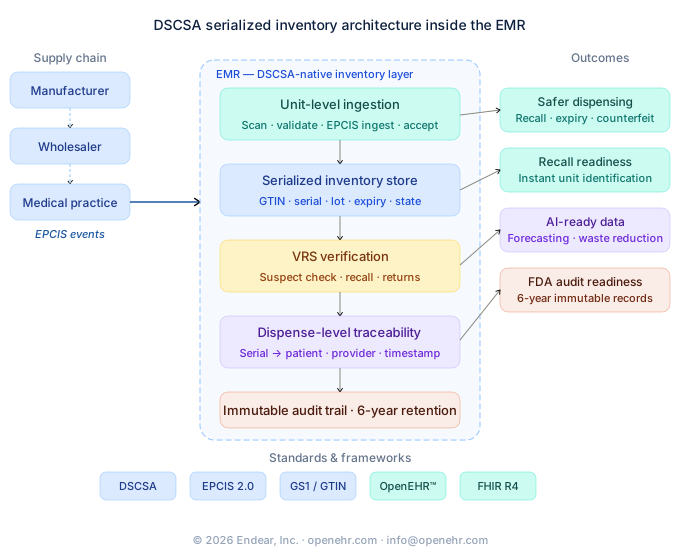
DSCSA replaces this entirely. Instead of managing quantities, EMRs must now manage identities. Every saleable unit of a prescription drug carries a unique product identifier encoded in a 2D barcode — a combination of GTIN, serial number, lot number, and expiration date. This identifier travels with the product from manufacturer to dispenser, and every transaction along the way must be captured as a structured EPCIS event.
The inventory model shifts from "we have 100 units of Drug X" to "we have 100 uniquely identifiable pharmaceutical assets, each with a verifiable chain of custody."
This is not an incremental upgrade to existing inventory systems. It requires a fundamentally different data model, new integration points, and workflows that most EMR platforms were never designed to support.
The Four Pillars of Serialized Inventory in the EMR
Unit-Level Ingestion at Receiving
Receiving drugs at a medical practice is currently a largely administrative act — boxes arrive, staff verify the count against the packing slip, and product is moved to the shelf or dispensary. DSCSA changes this into a structured digital workflow.
When drugs are received under the DSCSA framework, the EMR must ingest EPCIS data from the shipment — either by scanning 2D barcodes on individual units or by processing electronic transaction documentation from the supplier. Each unit's serial number is validated against the accompanying Transaction Information and Transaction Statement. The system verifies that the product's chain of custody is complete and legitimate before it enters the practice's inventory as an accepted asset.
Receiving is no longer signing for a delivery. It is accepting 1,000 uniquely identifiable pharmaceutical assets with verified provenance — and your EMR needs to record all of it.
Real-Time Verification via VRS Integration
Before dispensing — and in some cases before accepting returns — EMRs may need to verify products through a Verification Router Service. The VRS network is the pharmaceutical industry's shared infrastructure for confirming that a product's serial number is valid, that it has not been flagged as suspect or counterfeit, and that it is not subject to an active recall.
This introduces real-time external dependencies into clinical workflows that have historically been entirely self-contained. The dispensing workflow can no longer complete without confirmation from an external verification service. For EMRs built on synchronous, session-based workflows, this is an architectural challenge that requires careful design to avoid creating bottlenecks in patient care.
Event-Driven Inventory State via EPCIS
In a DSCSA-compliant system, inventory is not a static count — it is a timeline of verifiable events. Each serialized unit progresses through a defined set of states: commissioned by the manufacturer, shipped to the distributor, received at the practice, placed in inventory, dispensed to a patient, or in some cases returned or destroyed. Each state transition is captured as an EPCIS event with a timestamp, a location, and the identity of the acting party.
This event-driven model is a significant departure from the CRUD-based data models that underpin most EMRs. Rather than updating a quantity field, the system appends an immutable event to the unit's history. The current state of any item in inventory is derived from its event history, not from a single field value. For practices accustomed to simply adjusting counts, this is a conceptual shift as much as a technical one.
Dispense-Level Traceability Closing the Loop
The culmination of the serialized inventory model is at the point of dispensing. When a provider or staff member dispenses medication to a patient, the EMR must record not just that a unit was dispensed, but precisely which unit — its serial number, lot, expiration, and the full provenance record that brought it to the practice.
This creates what regulators and patient safety advocates have long sought: a closed-loop trace from manufacturer to patient. Every dose dispensed is linked to the specific physical product that was given, to the specific patient who received it, by the specific provider who authorized it, at the specific time it occurred. In the event of a recall, contamination event, or adverse reaction investigation, this trace is not reconstructed from partial records — it is simply retrieved.
The contrast with today's documentation is stark. Today: "Dispensed 1 unit of Drug X from stock." Tomorrow: "Dispensed serial #XYZ123, lot AB456, expiring 2027-08, received from Distributor Y on 2026-03-15, verified via VRS at time of dispense, to Patient Z, authorized by Provider W."
Impact on Medical Practice Workflows
Receiving Becomes a Controlled Digital Process
The receiving dock or medication storage room becomes a data capture point. Staff must scan incoming units, validate their credentials against EPCIS data and transaction documentation, and explicitly accept or reject each shipment in the system. Exceptions — invalid serial numbers, unknown suppliers, missing documentation — are no longer handled informally. They trigger formal investigation workflows that the practice must manage and document.
For practices currently receiving medications with minimal process overhead, this is a significant operational adjustment. Training, hardware (barcode scanners or mobile devices), and revised standard operating procedures are all required before this workflow can function effectively.
Dispensing Becomes Inventory-Aware
Today, dispensing is largely decoupled from inventory management in most practice settings. A provider prescribes or dispenses medication, and a separate process updates the inventory count at some later point. DSCSA eliminates this separation. Dispensing must select a specific serialized unit from available inventory, and the system must enforce rules: expired products cannot be selected, recalled lots are quarantined, and units that have not been received and validated cannot be dispensed.
This coupling of clinical and supply chain workflows inside the EMR is new territory. It requires the EMR to present inventory availability information to clinical users in real time, and to enforce supply chain policy at the point of care — a capability that most systems were not designed to provide.
Exception Handling Becomes a Core Competency
Medical practices have not historically needed workflows for suspect product investigations or FDA notification procedures. DSCSA changes this. When a product cannot be verified — or when there is reason to believe a product may be counterfeit, diverted, or adulterated — the practice must quarantine the product, investigate its provenance, and in some cases report to the FDA within defined timeframes.
For most small and mid-size practices, building this capability is entirely new. The EMR must support quarantine workflows that prevent flagged products from being dispensed while investigations are pending. Staff must be trained on escalation procedures. Documentation must be maintained that is sufficient to satisfy an FDA inquiry or inspection.
Audit Readiness Becomes Continuous, Not Periodic
DSCSA mandates six-year retention of transaction documentation, with the ability to produce records on FDA request. This is not a requirement that can be satisfied by archiving paper files or exporting spreadsheets annually. It requires that the EMR maintain an immutable, queryable record of every product received, every verification performed, every unit dispensed, and every exception encountered — accessible rapidly and completely.
This elevates the EMR from a clinical documentation tool to a regulated system of record for drug supply chain data. The implications for data architecture, backup, and disaster recovery are significant. Records that were previously low-stakes clinical notes now carry regulatory retention obligations and must be treated accordingly.
Architectural Implications for EMR Platforms
The gap between what existing EMR systems provide and what DSCSA compliance requires is substantial. Traditional EMR data models represent medication inventory as simple quantity records in relational tables. DSCSA requires an identity-based inventory model where each unit is a distinct object with its own history. Traditional EMRs process workflows synchronously and self-containedly. DSCSA requires real-time integration with external VRS services and asynchronous EPCIS event streams. Traditional EMRs are optimized for clinical documentation workflows. DSCSA requires high-volume data ingestion through AS2 gateways and structured EPCIS XML or JSON processing.
Legacy systems will struggle with all of this. The most common failure modes will be practices attempting to layer DSCSA compliance onto systems that were never designed to support it — resulting in parallel manual processes, incomplete audit trails, and compliance gaps that are invisible until an inspection reveals them.
The platforms that will serve practices well are those built — or substantially re-architected — around open standards from the ground up. OpenEHR's archetype-based data model is well-suited to representing the complex, event-driven inventory objects that DSCSA requires, because it separates the data structure (archetypes) from the application logic. New data models for serialized inventory can be introduced without replacing the underlying platform. FHIR APIs provide the interoperability layer needed to connect EMR inventory systems with external VRS services and supply chain partners.
The Strategic Opportunity
It is easy to read this as a compliance burden — another set of requirements demanding investment in systems and processes that do not directly improve patient care. That framing misses the larger opportunity.
Practices that build DSCSA-compliant serialized inventory capabilities are simultaneously building the data infrastructure for capabilities that were previously impossible. Proactive recall management that automatically identifies and quarantines affected units before a patient encounter. AI-driven inventory optimization that predicts stockouts and waste based on serialized usage patterns. Automated adverse event investigations that can trace a specific dispensed unit back through its full supply chain history. These are not theoretical future capabilities — they are direct outputs of the serialized inventory data that DSCSA compliance generates.
The regulatory requirement is real and the timeline is enforced. But the practices that approach this as an infrastructure investment rather than a compliance checkbox will emerge with capabilities that genuinely differentiate their operations and improve patient safety.
Conclusion
DSCSA is not simply another regulatory requirement. It is forcing a long-overdue evolution in the role of the EMR — from a passive system for recording clinical events to an active, verified, and auditable platform that sits at the intersection of clinical care and pharmaceutical supply chain integrity.
The EMR of the future will not just know what was prescribed. It will know exactly what was dispensed, where it came from, whether it was safe at the time of dispense, and how it moved through the supply chain before arriving at the patient. That is a fundamentally more capable and trustworthy system — and it is exactly the direction that modern, open-standard platforms like OpenEHR are built to support.
We are at the beginning of this transition. The practices that move early will be the ones that are ready when their patients need them to be.
See OpenEHR in action.
AI-powered EMR hosting with HIPAA compliance, FHIR APIs, and telehealth built in.
Schedule a Demo