Introduction
Electronic Medical Records have long served as the digital backbone of modern healthcare, enabling providers to store, retrieve, and manage patient data efficiently. However, traditional EMR systems often fall short in usability, interoperability, and actionable intelligence.
The emergence of Artificial Intelligence is reshaping this landscape — turning EMRs from passive data repositories into intelligent, adaptive systems that actively enhance clinical decision-making, operational efficiency, and patient outcomes.
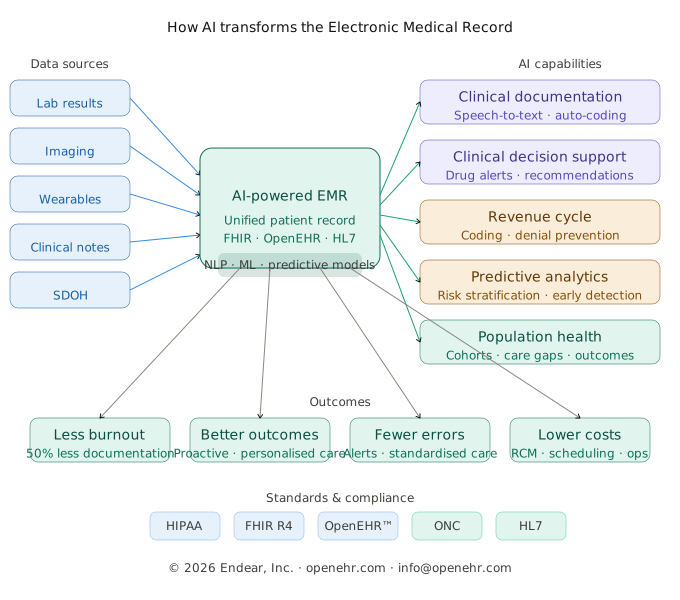
- AI reduces clinical documentation time by up to 50%, directly addressing provider burnout
- Predictive analytics enable proactive care — identifying sepsis, diabetes complications, and cardiovascular risks before symptoms emerge
- FHIR-based AI integration unifies fragmented data from labs, imaging, wearables, and external systems into a single longitudinal record
- AI-powered coding and billing assistance improves revenue capture and reduces claim denials
- Early warning systems and automated compliance checks reduce adverse events and strengthen regulatory posture
- OpenEHR's open-standard architecture is built for this AI-enabled future — add intelligence without replacing your core infrastructure
1. From Data Storage to Clinical Intelligence
Traditional EMRs primarily function as structured data storage systems. AI introduces a paradigm shift by enabling:
- Predictive analytics for early disease detection
- Clinical decision support systems (CDSS) powered by machine learning
- Real-time risk stratification
AI models can analyze longitudinal patient data to identify early signs of conditions such as sepsis, diabetes complications, or cardiovascular risks — often before symptoms become clinically evident.
Impact: Providers move from reactive to proactive care, improving patient outcomes and reducing hospital readmissions.
2. Enhancing Provider Efficiency and Reducing Burnout
One of the most significant challenges in healthcare is provider burnout, often driven by administrative overload. AI addresses this through:
- Automated clinical documentation (speech-to-text + NLP)
- Smart chart summarization
- Automated coding and billing assistance
AI-powered tools can transcribe physician-patient interactions in real time, extract relevant clinical concepts, and populate EMR fields automatically — reducing documentation time by up to 50%, allowing providers to focus more on patient interaction, and improving accuracy in coding and compliance.
3. Improving Clinical Decision-Making
AI-enhanced EMRs provide context-aware recommendations by integrating evidence-based guidelines, patient-specific data, and population health insights. Examples include:
- Drug-drug interaction alerts with reduced false positives
- Personalized treatment recommendations
- Diagnostic assistance using imaging and lab trends
Impact: More accurate diagnoses, reduced medical errors, and standardized care delivery across providers.
4. Interoperability and Data Integration
AI plays a crucial role in overcoming one of EMR's biggest limitations — fragmented data:
- Natural Language Processing (NLP) extracts data from unstructured notes
- FHIR-based integrations enable cross-system data exchange
- Data normalization and mapping across disparate systems
AI can harmonize data from labs, imaging, wearable devices, and external health systems into a unified patient record.
Impact: A comprehensive, longitudinal patient view that supports coordinated and continuous care.
5. Personalized and Value-Based Care
AI enables a shift toward personalized medicine by analyzing genetic data, lifestyle factors, and social determinants of health. EMRs enhanced with AI can:
- Identify high-risk patient cohorts
- Recommend individualized care plans
- Support value-based care models
This improves patient engagement, enables better chronic disease management, and optimizes resource utilization across the care continuum.
6. Operational Optimization and Revenue Cycle Management
Beyond clinical care, AI significantly improves operational workflows:
- Patient scheduling optimization and no-show prediction
- Revenue cycle automation
- Claims denial prediction and prevention
- Staffing and resource allocation recommendations
Impact: Reduced operational costs, improved revenue capture, and more efficient healthcare delivery.
7. Quality of Care and Patient Safety
AI-driven EMRs enhance patient safety through early warning systems, automated compliance checks, and continuous monitoring of clinical quality metrics:
- Detecting anomalies in vital signs
- Alerting clinicians to critical lab results
- Ensuring adherence to care protocols
This reduces adverse events, improves clinical outcomes, and enhances regulatory compliance — all of which matter deeply to payers and accreditation bodies.
8. Future Outlook: Toward Intelligent Health Platforms
The future of EMR lies in its evolution into an intelligent health platform, integrating AI and ML models, real-time data streams, interoperable APIs such as FHIR, and modern identity and access management.
As organizations adopt cloud-native architectures and integrate clinical data repositories, identity management, and event streaming, EMRs will become more scalable, secure, and intelligent.
OpenEHR's open-standard architecture is built precisely for this future — enabling organizations to add AI modules, FHIR APIs, and clinical intelligence without replacing their core records infrastructure.
Conclusion
Artificial Intelligence is not just enhancing EMRs — it is redefining their role in healthcare. By transforming static records into dynamic, intelligent systems, AI empowers providers to deliver more efficient, accurate, and personalized care.
Healthcare organizations that embrace AI-driven EMR transformation will be better positioned to improve clinical outcomes, reduce provider burnout, optimize operations, and transition to value-based care models.
The convergence of AI and EMR marks a critical step toward a smarter, more connected, and patient-centric healthcare ecosystem. As healthcare systems evolve, integrating AI with open, interoperable platforms will be key — and leveraging modern infrastructure and standards will ensure scalability and long-term innovation in digital health.
See OpenEHR in action.
AI-powered EMR hosting with HIPAA compliance, FHIR APIs, and telehealth built in.
Schedule a Demo